About this course
The recommended beginner freediving course on Oahu.
AIDA 1+2 is a two-day beginner freediving course on Oahu, built for anyone with no prior experience who wants a complete, certifiable introduction rather than just a taste of the pool. Over two days, you will learn in theory, confined water, and open water at a pace that feels comfortable. The AIDA 2 certification depth requirement is 12m. Training may continue to a maximum of 20m when appropriate, but reaching 20m is not required.
Freediving means diving on a single breath, without tanks. Day one is mostly theory and confined water, meaning a pool or sheltered, calm-water site. Day two moves to open water, where you dive along a line with me beside you. Certification is awarded only after all applicable theory, confined-water, open-water, safety, rescue, and performance requirements are successfully completed.
Freediving is about relaxation and trust, so we move at your pace and take the time to make sure every concept clicks. Most students are surprised by how quickly things come together once they're comfortable in the water.
In the pool and confined-water sessions you will practise static and dynamic apnea alongside the core open-water skills: equalization (balancing the pressure in your ears as you descend), duck diving, vertical swimming, body positioning, turns, and buoyancy control. Theory covers the breathing cycle, basic physiology, equalization, technique, safety, equipment, and the freediving disciplines. You will build the core skills needed to freedive safely with a trained buddy.
Once you've earned your AIDA 2 certificate you can progress to the AIDA 3 Advanced course.
What's included in this course
- Knowledge development through practical theory lessons
- Pool session: static apnea
- Pool session: dynamic freediving
- Open-water training at your pace: 12m certification requirement and 20m / 65 ft maximum course depth
- Equalization techniques & rescue skills
- Breathing & freediving techniques
Types of freediving in this course
- Static apnea: holding your breath while floating face down and staying still, in a pool or other confined water. Your face stays submerged. We build the hold up gradually and always with supervision. It is never a competition and you are never asked to force it.
- Dynamic apnea: swimming a distance underwater, horizontally, on one breath, with or without fins. The focus is relaxed, efficient technique rather than distance.
- Constant weight: descending and ascending in open water under your own power, using fins (or none), carrying the same weight the whole dive and without pulling on the line. This is the standard recreational depth discipline.
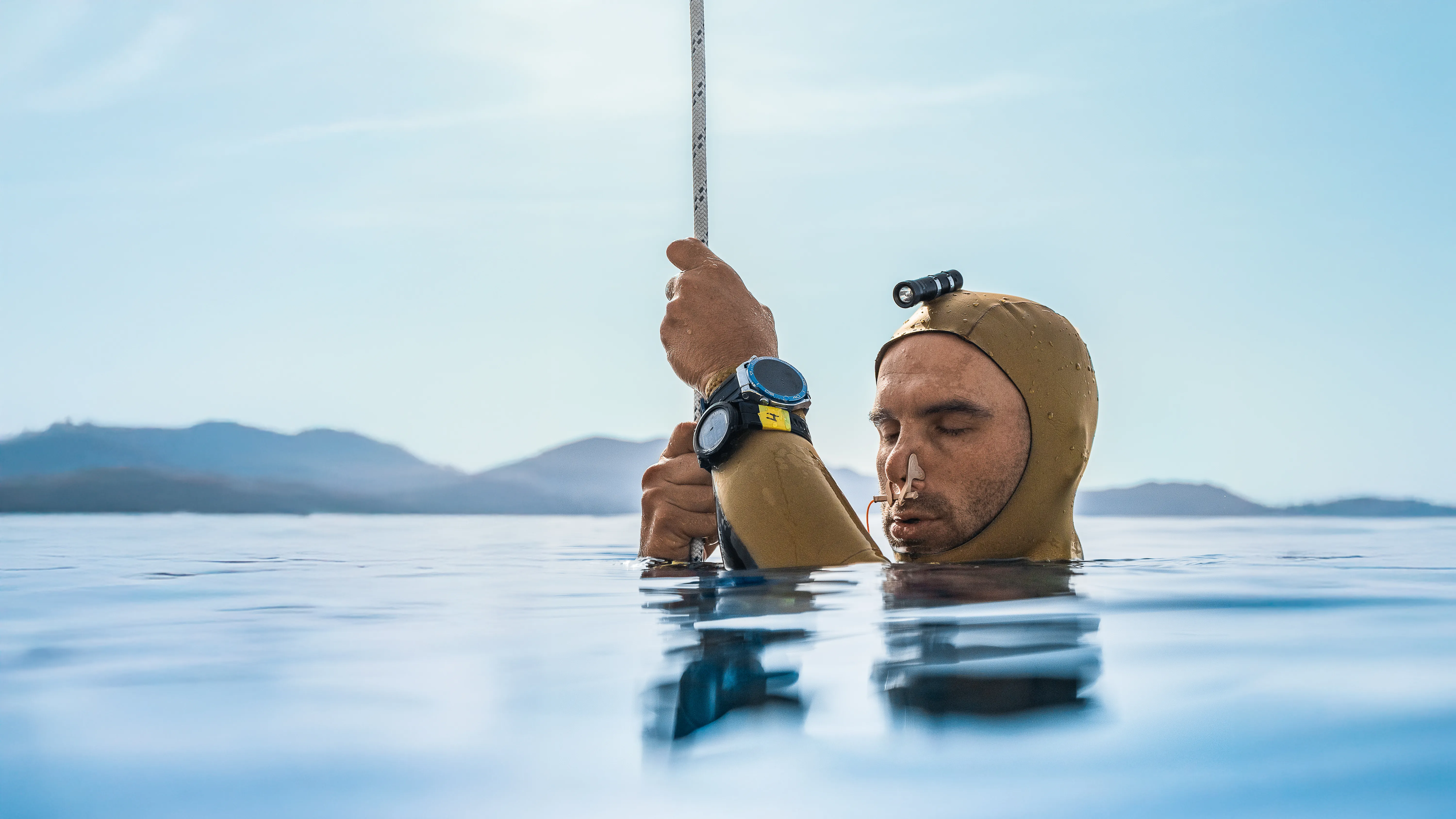
- Free immersion: descending and ascending by pulling hand-over-hand along a vertical rope, without fins. It is slow and controlled, which makes it the easiest way to learn equalization and body positioning.
Before you book
- Price: $425 per person.
- Daily schedule: 7:30 AM – 2:00 PM, both days.
- Separate dates: The AIDA 1+2 course usually runs on consecutive days. Separate dates may be possible by prior arrangement. Contact Mitch before booking to confirm a schedule that works for your training and the available course dates.
- Class size: maximum 6 students.
- Equipment provided: fins, mask, snorkel and a weight belt.
- Wetsuit: not provided and highly recommended. If you need a wetsuit, contact a local dive shop before your course to confirm rental availability, sizing, and opening hours. Arrange the rental before the morning of your course.
- If you do not finish every requirement: booking a course does not guarantee certification. If something is still outstanding at the end, I will tell you exactly what remains and what to practise, and you have one year to complete it. If certification is your goal we stay in touch and keep working on it.
Safety and participant requirements
Freediving and ocean activities involve inherent risks, including loss of motor control, blackout, drowning, pressure-related injury, changing ocean conditions, marine life, boats, and equipment problems. Participants must follow instructor directions, use required safety procedures, complete all applicable participant and medical forms, and never practice freediving alone. Course enrollment does not guarantee certification or a particular performance result. This notice is not a substitute for the separate participant agreement and written release required for participation.
Read the Website Terms and Cancellation and Refund Policy before booking.
What equipment you need
Fins, mask, snorkel, and a weight belt are provided. Wetsuits are highly recommended. If you need a wetsuit, contact a local dive shop before your course to confirm rental availability, sizing, and opening hours. Arrange the rental before the morning of your course.
For each day of the course, I recommend having:
- Wetsuit
- Sunscreen
- Water
- Yoga mat or towel
- Change of clothes
- Notepad
- Slippers
Prerequisites
- Be 18 years of age or older (16 or 17 years old with parent or guardian consent)
- Can swim at least 200m non-stop without fins or at least 300m non-stop with mask, fins and snorkel
- Be able to speak and read English
Ready to go deeper?
Once you hold a beginner freediving certification you can continue to AIDA 3, a three-day advanced course. The AIDA 3 certification depth is 24m, and the course includes training up to a maximum of 30m / 100 ft.
Continue to the AIDA 3 advanced freediving courseBack to the one-day AIDA 1 beginner course · Next step: the AIDA 3 advanced course · Compare freediving course options · Not sure this is the right fit? Compare AIDA 1 vs AIDA 2 · How deep must you dive for AIDA 2? · Where and how courses run on Oahu · Prerequisites and FAQ · How Mitch teaches and approaches safety · Need extra practice? Private training